
International Property Investment: The Expat Guide to UK, Thailand & Bali
By The Eight Co. | April 2026 | 8 min read | UK Property Investment

Why Expat Investors Are Diversifying Into International Real Estate
Something structural has shifted in how sophisticated investors think about real estate. A decade ago, property investment meant buying close to home, somewhere familiar, somewhere you could drive past on a Sunday. Today, that model is giving way to a more deliberate, geographically dispersed approach.
The reasons are interconnected. Inflation has eroded purchasing power across developed economies, prompting investors to seek assets that hold real value across currency cycles. The remote work revolution has decoupled income from geography, giving an entire generation of professionals the freedom to ask not just where they earn, but where their capital works hardest. And a growing number of high-income expats, entrepreneurs, consultants, corporate executives, now structure their lives across multiple countries as a matter of preference, not necessity.
For these investors, international property investment is less a gamble and more a logical extension of a globally diversified life. Currency hedging, rental income in multiple denominations, and portfolio exposure to markets at different stages of the economic cycle these are not exotic strategies. They are the fundamentals of modern wealth management, applied to real estate.
The question is no longer whether to invest internationally. It is where, in what structure, and with what strategic intent.
The Global Property Investment Landscape in 2026
Many British expatriates and internationally mobile investors we speak with today are no longer asking whether to invest overseas but how to structure property ownership across multiple countries. With currencies moving, lifestyle migration stabilising, and income diversification becoming a priority, property is increasingly viewed as part of a global strategy rather than a single-market decision.
Where are expats investors putting money in 2026?
After years of pandemic-driven relocation and rapid market shifts, global property is entering a more mature phase. Lifestyle migration has stabilised, tourism across Southeast Asia has surpassed pre-pandemic levels, and UK rental demand remains constrained by chronic housing undersupply.
Here’s the bigger picture shaping international property investment this year.
Post-pandemic property markets have matured significantly. The initial surge in lifestyle migration driven by remote work flexibility has settled into more structural demand patterns. Tourism has rebounded beyond pre-pandemic levels across Southeast Asia. Rental demand in major UK cities remains tight, underpinned by chronic housing undersupply. And international capital continues to seek stable, yield-generating assets.
Three market dynamics are shaping global property investment:
• Currency opportunity: Favourable entry points across sterling and Southeast Asian markets
• Rental demand growth: Professionalised short-term letting expanding income potential
• Regulatory evolution: Clearer foreign ownership frameworks across Southeast Asia
Against this backdrop, three markets stand out for expatriate investors: the United Kingdom, Thailand, and Bali, each serving a distinct role within an internationally diversified property portfolio.
Investing in UK Property: Stability, Transparency, and Proven Returns

The United Kingdom remains one of the most institutionally trusted property markets in the world — and with good reason. Legal frameworks are mature, title is clear, and the rental market is underpinned by structural housing undersupply that shows no sign of resolution in the near term.
For overseas investors, UK property offers several distinct advantages:
Legal certainty: Property rights are well-defined under English law. Leasehold and freehold structures are internationally understood, and dispute resolution mechanisms are robust.
Transparent ownership: Foreign nationals face no ownership restrictions. Purchases are registered with HM Land Registry, providing full transparency and title security.
Pound sterling exposure: For investors whose primary income is in USD, EUR, or SGD, sterling-denominated property provides natural currency diversification.
Mature rental market: Major UK cities, particularly Manchester, Birmingham, Leeds, and London commuter zones exhibit sustained rental demand from a broad tenant base, including students, young professionals, and corporate relocatees.
Long-term capital appreciation: UK residential property has delivered consistent real-terms appreciation over multi-decade timeframes, weathering multiple economic cycles.
Gross rental yields typically range from 4–6% in the major regional cities, with net yields after management fees, maintenance, and taxation generally landing in the 3–5% range. Buy-to-let demand remains structurally strong, driven by a generation of renters priced out of homeownership.
Investors often retain UK property as the stabilising foundation of an international portfolio, complementing it with higher-yield opportunities overseas. Examples of projects aligned with this diversified approach can be viewed within our current investment developments.
Investing in Thailand Property: Yield, Lifestyle, and the Asia Premium

Thailand occupies a unique position in the international investment landscape. It combines genuinely competitive rental yields with an unmatched lifestyle offering and a cost-of-living arbitrage that continues to attract retirees, remote workers, and investors from across the globe.
The Bangkok condominium market serves institutional grade demand from expatriate professionals, while resort markets — Phuket, Koh Samui, and Pattaya, benefit from one of Asia's most robust and recovering tourism ecosystems. International visitor arrivals to Thailand surpassed 35 million in 2024, with projections pointing higher into 2026.
The Investment Case
Rental yields: Well-located condominiums and pool villas in Phuket's prime corridors — Bang Tao, Rawai, and Patong — typically deliver gross yields of 6–10%, with branded resort-managed units frequently outperforming equivalent-quality assets across Western markets.
Tourism resilience: Phuket welcomed over 10 million international visitors in 2024, making it one of Southeast Asia's most visited destinations. Its appeal beaches, gastronomy, and year-round tropical climate — underpins sustained short and long-term rental demand regardless of broader economic cycles.
Retirement and lifestyle migration demand: Thailand's Long-Term Resident (LTR) visa programme has positioned Phuket as a preferred destination for high-net-worth retirees and remote professionals from Europe, the Middle East, and beyond — directly supporting demand for quality residential and lifestyle property.
Entry price accessibility: Quality condominiums in established Phuket locations are available from approximately £65,000–£220,000, with pool villa opportunities typically starting from £180,000 offering meaningful yield potential at a fraction of the capital required in comparable UK or European resort markets.
Ownership Structures and Legal Considerations
Foreign nationals may own condominium units outright, subject to the 49% foreign quota restriction per development. Land and villa ownership requires leasehold structures — typically structured as 30-year leases with renewal options or acquisition through a legally compliant Thai company. These structures are widely used and understood; however, they require proper legal documentation and due diligence.
Investors should approach any off-plan purchase with caution, ensuring developer track records are thoroughly verified and completion guarantees are contractually secured.

For investors interested in understanding how specific opportunities in Phuket fit within an international property strategy, this month we are hosting a private virtual golf investor event in Singapore, where we will discuss one of the most compelling current opportunities in Phuket, the Banyan Tree Residences, in an informal, discussion-led setting. Details and registration can be found here.
If you are unable to join from Singapore but would like to receive the investment information, please let us know and we will be happy to share the details directly with you.
Investing in Bali: The Digital Nomad Economy and the Hospitality Premium

Bali has undergone a fundamental transformation. What was once a tourist destination has become a destination economy, a place where a growing cohort of location-independent professionals live, work, and invest. This shift has created one of the most dynamic short-term rental markets in Asia.
Villa ownership in Bali, particularly in the Canggu, Seminyak, Ubud, and Uluwatu corridors can generate short-term rental yields of 8–15% gross, driven by sustained platform demand and premium nightly rates. The key variable is management quality: professionally managed villas consistently outperform self-managed equivalents.
Indonesia's Golden Visa programme, launched in 2022 and expanded subsequently, has provided a clearer pathway for foreign investors, requiring a minimum investment threshold in qualifying assets. The programme has materially increased institutional interest in Bali's property market.
Ownership Structures
Indonesia restricts direct foreign land ownership. Foreign investors typically access the market through leasehold agreements (commonly 25–30 years with options to extend) or via a PT PMA, a foreign-owned limited company permitted to hold property rights. Both structures carry legal validity when properly executed; the critical factor is engaging qualified Indonesian legal counsel and conducting thorough title verification.
Risks to Acknowledge
Leasehold structures do not confer freehold title exit strategy planning is essential from the point of acquisition.
Bali's short-term rental market is subject to regulatory evolution; investors should monitor zoning and licensing requirements.
High yields require high occupancy which in turn requires professional management, marketing capability, and strong platform relationships.
Building a Resilient International Real Estate Portfolio
The most sophisticated international investors do not approach overseas property as a collection of individual purchases. They construct portfolios deliberately assembled combinations of assets that serve distinct roles within a broader wealth strategy.
A three-market portfolio framework anchored by a UK asset for stability, complemented by a Thai condominium for income yield, and enhanced by a Bali villa for higher-return lifestyle exposure, illustrates how geographic diversification can balance capital preservation with growth.
Core Portfolio Principles
Income vs. appreciation: Allocate between assets that generate current income (Thai condos, Bali villas) and assets that prioritise long-term capital growth (UK residential in undersupplied catchments).
Currency diversification: Multi-currency income streams reduce the impact of any single exchange rate movement on overall portfolio returns.
Risk tiering: Each market occupies a different position on the risk spectrum. UK property is low-volatility; Bali short-term rental is higher-yield, higher-variability. A balanced portfolio acknowledges and manages this distribution intentionally.
Exit liquidity planning: Liquidity profiles differ materially across markets. UK property is broadly liquid; Bali leasehold has a more constrained resale market. Entry decisions should incorporate exit assumptions.
Management infrastructure: A portfolio is only as strong as its on-the-ground management. Professional property management — ideally through a single coordinating advisory, is the difference between passive income and active stress.
Common Mistakes First-Time International Property Investors Make
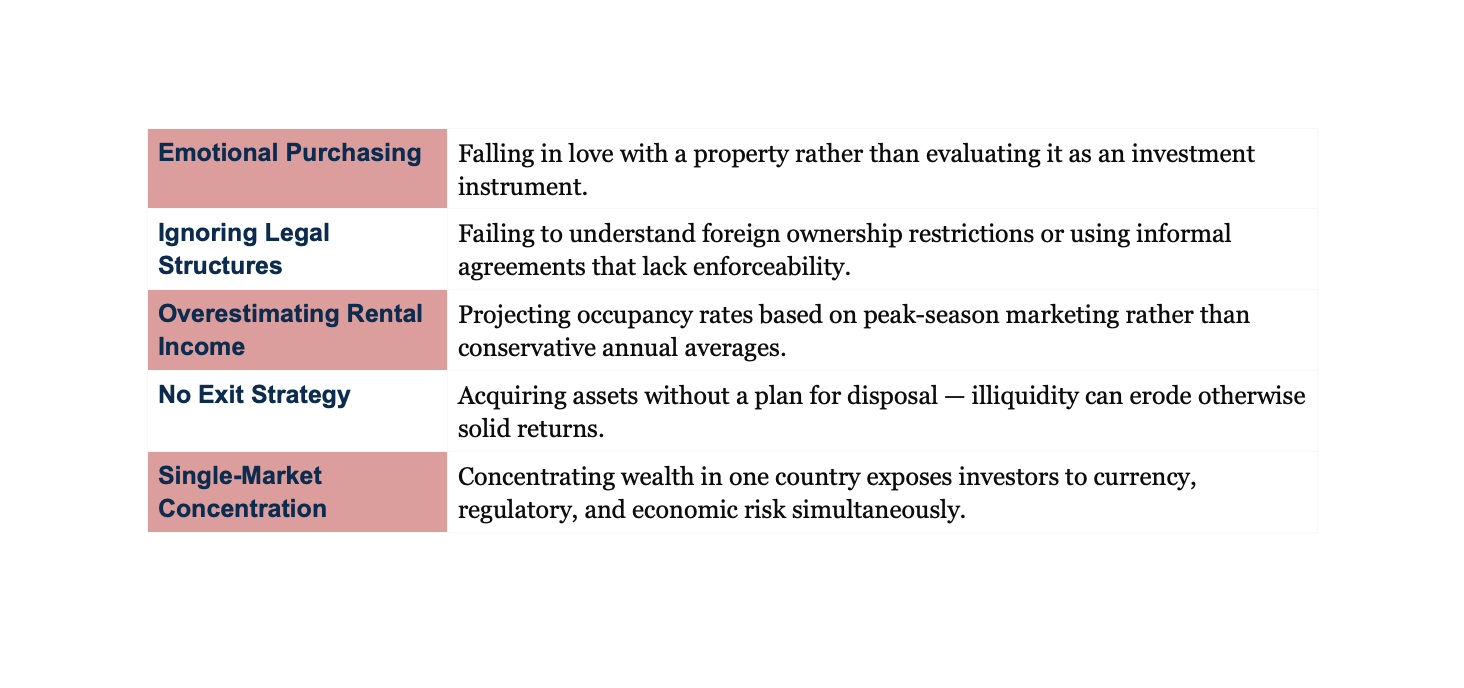
Even experienced domestic investors can encounter significant pitfalls when entering international markets for the first time. Understanding these common errors is as valuable as understanding the markets themselves.
Expert Perspectives: The Long View on International Property
The most successful international property investors share a common characteristic: they think in decades, not quarters. They understand that property, wherever it is located, is a medium to long-term asset class, and that the compounding benefits of rental income reinvested over time will typically dwarf any short-term market movement.
Time in market, consistently, outperforms attempts to time the market. The investors who acquired UK residential property in 2008, Thai condominiums during the 2014 political uncertainty, or Bali villas in 2020 were rewarded not because they called market bottoms, but because they maintained conviction and held quality assets through cycles.
Portfolio resilience comes from construction, not prediction. A well-constructed international portfolio, with assets across legal jurisdictions, currencies, and rental market types, is materially more resilient to any single shock than concentrated domestic exposure.
The role of a strategic advisor in this context is not to generate excitement about the next hot market. It is to help investors construct, manage, and evolve a portfolio that serves their specific financial goals, whether those goals are income generation, capital preservation, lifestyle optionality, or some deliberate combination of all three.
"The best international property portfolios are not assembled by chasing yields. They are built by investors who understand that diversification is a discipline and who have the patience to allow quality assets to compound over time."
Why us?
Building a cross-border property portfolio requires more than market knowledge. It requires an understanding of your specific financial position, risk tolerance, tax residency, and long-term objectives and the ability to translate those factors into a coherent acquisition strategy across multiple legal and regulatory environments.
At the 8Co we work with expats, entrepreneurs, and globally mobile investors to design, build, and manage international property portfolios spanning the UK and Southeast Asia. Our approach is advisory first , beginning with your portfolio objectives and working backwards to the right assets, in the right markets, at the right time.
If you are considering your first international property investment, or looking to restructure an existing portfolio for greater resilience and income, we invite you to arrange a complimentary portfolio consultation with one of our advisors.
Request a Free International Portfolio Consultation today.
Disclaimer: The information provided in this article is for informational and educational purposes only and does not constitute legal, financial, or investment advice. While we strive for accuracy, property laws and tax regulations in the UK, Thailand, and Bali are subject to frequent changes. Readers are strongly advised to conduct their own due diligence and consult with qualified legal and financial professionals in each respective jurisdiction before making any investment decisions. The 8Co and the author assume no liability for any actions taken based on the content of this guide.